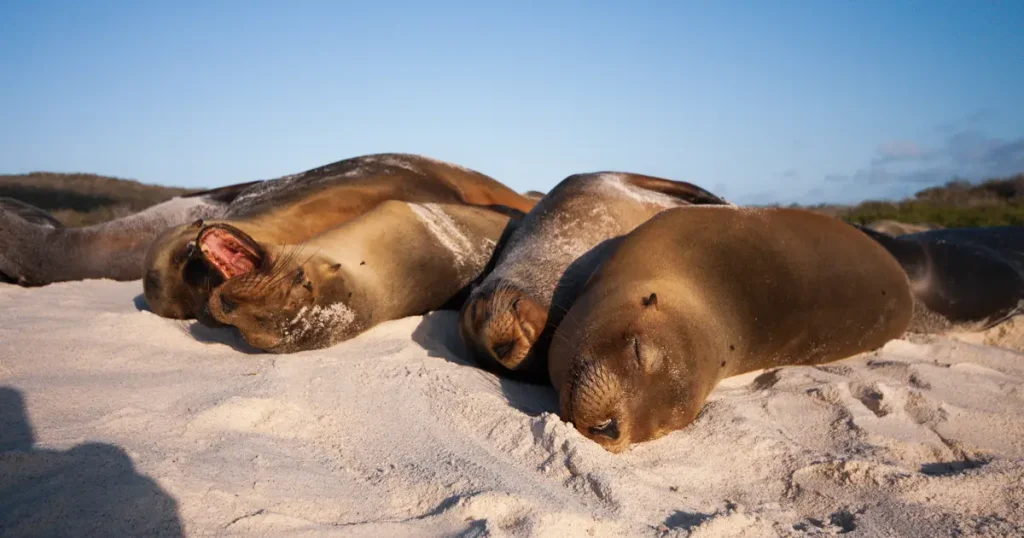
Along the volcanic shores of Galápagos, the first rays of sunlight reveal sea lions stretched across the rocks, their gruff barks carrying through the morning air. These moments—familiar and timeless—remind us what makes these islands so extraordinary.
Here, two endemic pinnipeds—the Galápagos sea lion and the Galápagos fur seal—coexist under demanding and highly specific conditions. Both are endangered, their lives shaped by the rhythm of the ocean and the pressures of a warming world.
The data collected tells a story of contrast and resilience. While some eastern rookeries are showing signs of recovery, others closer to human settlements continue to decline. Events like El Niño, which warm the ocean and reduce fish availability, can devastate entire populations in a matter of months. Still, amid these challenges, the work of scientists is revealing the remarkable capacity of these species to respond and endure.
For Dr. Diego Páez-Rosas, researcher at Universidad San Francisco de Quito and Research Associate at Galápagos Conservancy, long-term monitoring is crucial. “Continuous monitoring doesn’t just tell us how many animals remain— it shows us how they’re responding to a changing environment. It’s an essential tool for reacting in time, especially when El Niño events can threaten entire populations,” he explains.
Recent research analyzing the isotopic signatures in the whiskers of pups has revealed something extraordinary: mothers move between feeding zones throughout the year to find food for their young. This trophic flexibility allows them to survive in one of the planet’s most unpredictable ecosystems. Health monitoring of pups also shows encouraging results—most are in good condition—but subtle changes in body fat and immune function could affect their future if warming trends continue.
Beyond the science, this effort is also nurturing a new generation of conservationists. Through a program supported by Galápagos Conservancy, more than 40 local high-school students joined researchers and park rangers to learn field methods, conduct population counts, and design community projects that raise awareness about marine conservation.
For many, the experience of seeing a newborn pup for the first time was life-changing—a spark that turned curiosity into purpose. This blend of science, education, and commitment defines the mission of Galápagos Conservancy: to protect wildlife through knowledge, collaboration, and shared responsibility. With the help of our donors, these programs are creating measurable impact—stronger data, engaged youth, and a renewed sense of stewardship across the Islands.
Each data set, each student, and each pup born in Galápagos shores carries a message of hope: even in a changing ocean, collaboration and compassion can help life endure. Together, we’re helping ensure that the songs of these coastal guardians will continue to echo across the islands for generations to come.