Blog - Birds

GUEST POST: Dr. Dave Anderson talks Blue-footed Boobies

We're pleased to have Dr. Dave Anderson guest-blogging about his recent trip to Galapagos to study population changes among the blue-footed boobies. Dr. Anderson is a Professor of Biology at Wake Forest University and long-time friend of Galapagos Conservancy.

With support from the Galápagos Conservancy, Galápagos Conservation Trust, and Swiss Friends of Galápagos, a group of seabird biologists (myself, Kate Huyvaert at Colorado State University, and Ecuadorian Master’s degree student David Anchundia) has begun the first comprehensive survey of blue-footed booby distribution and population dynamics in the archipelago.  This effort comes as a response to concerns of a number of long-time Galápagos observers that this iconic species seems to be declining in numbers.  Traditional breeding sites seem to be largely unattended and without successful nesting; indeed, the large colony of hundreds of nests at my group’s research site on Espanola Island has been essentially unused since 1997.

The project began in May, 2011 with a survey of the entire coastline of Galápagos, excluding the northern-most islands (Genovesa, Marchena, Pinta, Darwin, and Wolf, where blue-footed boobies almost never venture).  That effort revealed a critical clue: only two birds in juvenile plumage were seen in the entire survey area.  Blue-footed boobies show the distinctive juvenile plumage between the time that they become independent from their parents until around age 2 years.  This was a change from the 1980s and ‘90s, when birds in juvenile plumage were common throughout the archipelago, excepting the northern tier of islands.

The absence of these young birds at the beginning of the study was an immediate indication of something noteworthy in the Galápagos population of blue-footed boobies.

We have now completed four rounds of intensive searches of major breeding colonies in the archipelago, at four month intervals since May 2011.  During that first round of searches we were fortunate to find large aggregations of birds at most colonies, and we banded over 700 birds.  Since then, we have seen few of these birds, because attendance at breeding colonies has been very low.  And if they don’t try to breed, they don’t produce fledglings that can eventually recruit into the population, balancing natural losses of adults to old age and the other hazards of life.  The virtual absence of juveniles in May 2011 probably indicates that little successful breeding had been occurring for the previous two years (at least). 

In early June 2012, we conducted a coastal survey of blue-footed boobies, around the entire archipelago except the few northern islands that lack this species.  This effort required ten people in five different boats, and occurred over three consecutive days.  This method allowed us to minimize double-counting and misses due to movements of birds among sites.  Again, we found few juveniles ( < 100), consistent with the previous year’s data indicating little breeding.  Our preliminary estimate of the adult population size is 6,000-8,000 birds.  For comparison, the estimate from the 1960s and ‘70s was 20,000-30,000 breeding birds; the population also must have contained some pre-breeders.  The contrast between even these admittedly loose numbers suggests a substantial decline in population size, and the failure to breed offers a demographic mechanism for the decline.

Why are they not breeding?  We suspect that food is behind the failure to even try.  We know from previous work on Espanola that successful breeding there occurs when blue-footed boobies have access to sardines.  But sardines have been largely absent from the Espanola area since 1997 (we know this from Nazca boobies there, who also prefer sardines but can also breed using other prey).  Over the past year, we have found that approximately half (54%) of >500 individual prey items were sardines.  But this is much less than the essentially 100% that we have found in the diet during good times, and we suspect that the birds find this diet sufficient to live, but not to breed.  Other factors may be involved, but we have no evidence yet or effects of introduced predators, disease, persecution by humans.  

Taken together, the first results of our work are consistent with a difficult breeding environment, and possibly with a declining adult population that experiences typical adult mortality but little replenishment from recruitment by successful breeding in the past.  We plan to continue our monitoring of the population at four month intervals until January 2013 to provide as clear a picture as possible of the population status of this trademark Galápagos species.

The Power of Citizen Science

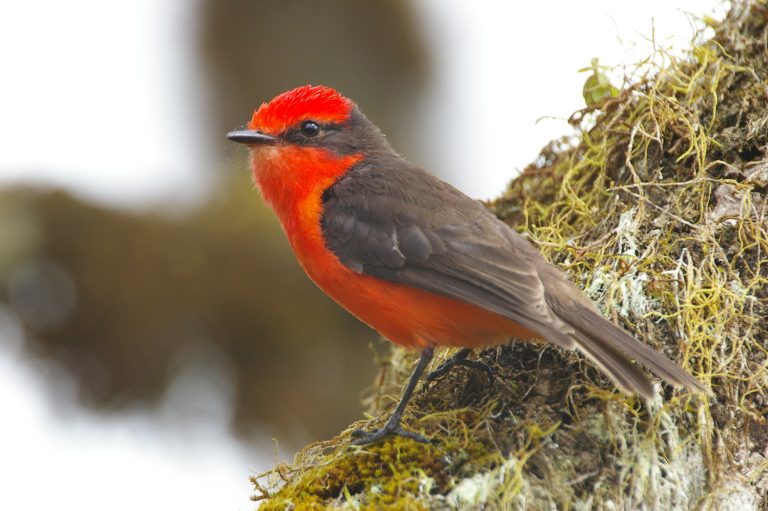
“Where have all the birdlets gone?” was the provocative and slightly plaintive title of an email I received last year from Godfrey Merlen.  Many of you know Godfrey’s decades of experience in Galapagos as a naturalist, scholar, and voice (many would say conscience) for conservation in the islands.  So the email caught my attention as did its plea for anecdotal information about the presence/absence of vermillion flycatchers in the highlands of Santa Cruz Island.  Comments trickled in from various corners reporting that a range of observers had noticed a decline in sightings over the years, but that these observations didn’t necessarily generate concern or action.

In the years that I have worked with scientists in Galapagos, I note they are measured in their use of anecdotes, preferring to make observations with robust data behind them.  What was refreshing, and later proved to be deeply compelling, was Godfrey’s confidence in making an observation, mulling it over, reaching out to a large community for confirmation, and seeing what resulted. In administrative review parlance, we might call it “kicking the tires.” And we are very glad that Godfrey started kicking.

Through a small grant from Galapagos Conservancy, Godfrey was able to do some basic library research to add to his own observational data.  He wrote “… It really seems that San Cristobal has lost the species, although David Steadman seems to have seen it prior to 1988.  Last seen on Floreana three years ago, declining on Santa Cruz.  We must not stand by and see these declines, especially since the various populations are the essence of evolutionary processes.”

Several thoughts come to mind as we consider Godfrey’s words.  One is the power of observation.  Charles Darwin and Benjamin Franklin were practitioners of this “amateur” or public participation in date gathering and analysis.  There is more than enough room in scientific pursuit to invite and encourage keen analysis by engaged observers.   Another is the fragility of species on our planet, especially as our wild places grow more imperiled.  Why species are disappearing is complex, but that they are disappearing, is unconscionable.  Today we mark “Endangered Species Day” in the US, a regrettable date to note.  And another is the inescapable, interconnected nature of our world.  Systems depend on each other and nowhere is that more clear than in Galapagos.  Not just our biological systems, but human systems, and the informational systems, formal and informal, which have come together to help answer Godfrey’s provocative question.

Recently, he wrote, “I am working in the library and it definitely seems the Warbler Finch has kicked the bucket on Floreana.  Peter Grant took up the subject a while back and nobody took much notice of that!”  We are taking notice.  And we are counting on our community to help us act swiftly and effectively.  We will continue to help our friends and colleagues in Galapagos respond to negative trends in all species in Galapagos.  We will work to save those remaining birdlets from extinction.  And we hope to have you with us as we do.

For Galapagos,

Johannah Barry
President, Galapagos Conservancy

For more information, visit Vermillion Flycatcher Population Analysis.

Twitter Feed

  • @SaveGalapagos
    Follow us on Twitter >
  • Latest News